
What goes wrong with most fence installs
A bad fence install isn’t usually obvious for the first year or two. Then the posts start leaning, the gates stop closing right, the boards twist, and the whole line looks tired by year five. The fixes are almost always traceable to install shortcuts:
- Posts not set deep enough. Frost line in the Triad is about 12 inches, but a fence needs 24-36 inches of post buried for stability against wind load, not just frost.
- No concrete, or concrete in a tube without a footing flare. Posts settle, lean, and pull out.
- Wood-to-soil contact rotting the post within 3-5 years.
- Galvanized hardware on pressure-treated lumber — the modern PT treatment (ACQ) eats galvanized fasteners. You need stainless or coated fasteners specified for ACQ.
- No drip cap on top of wood posts — water sits, posts rot from the top down.
We install fences the way you’d install one if you were planning to never replace it.
Fences we install
Wood privacy (most common)
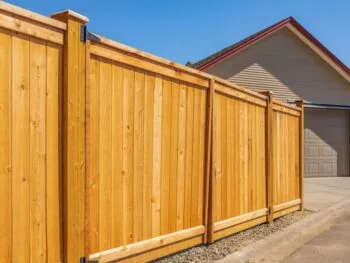
The standard suburban privacy fence — 6 feet tall, dog-ear or scalloped pickets, pressure-treated pine or cedar. We install with:
- 6x6 posts (heavier than the standard 4x4 most contractors use) on longer runs and for gates
- Posts set in concrete with a wide footing, not just in a hole filled with concrete
- 2x4 rails with proper spacing for board attachment
- Cedar or copper post caps to shed water off the post tops
Cedar costs more than pressure-treated pine but doesn’t twist and warp the same way, and it weathers to a silver gray that ages well.
Vinyl
Maintenance-free privacy and picket fencing. Premium vinyl (CertainTeed, Bufftech) is heavy-gauge with internal aluminum reinforcement in posts — not the hollow plastic version that bows in summer heat. Vinyl is a one-time install with no painting or staining for the next 25+ years.
- Lifespan: 25-40 years
- Best for: homeowners who don’t want to think about the fence again
- Style options: privacy, semi-private, picket, ranch rail
Aluminum ornamental
Black or bronze powder-coated aluminum, traditional pool-style fencing. Looks like wrought iron, doesn’t rust, can be made pool-code compliant for HOA pool enclosures.
- Lifespan: 30-50 years
- Best for: pool surrounds, front yard accents, where view-through matters
- HOA-friendly in most Triad neighborhoods
Chain link
We install chain link for utility applications — back-of-property dog runs, commercial yards, anywhere appearance isn’t the primary concern. Galvanized or black vinyl-coated, with proper terminal posts and tension wire.
Ranch rail and split rail
For larger lots — 1/2 acre plus — split-rail or post-and-rail fencing creates property definition without enclosure. We install in cedar, locust, or pressure-treated pine.
What goes into a proper fence install
- Survey and locate — confirm property lines, mark utility locations through 811
- Layout — string lines, post spacing (typically 6-8 feet)
- Post holes — 24-36 inches deep, 10-12 inches diameter, wider at bottom (bell-shape) for footing strength
- Concrete for every post — proper mix, proper depth, proper crown to shed water
- Plumb and brace every post until concrete cures
- Rails and pickets — squared, gapped consistently, fastened with the right hardware
- Gates with heavy-duty hinges, drop pins for double gates, and adjustable hardware for re-leveling
- Post caps to shed water off the tops
- Cleanup including any sod restoration disturbed during the install
HOA and property line considerations
In most Triad subdivisions, fences require HOA approval. We can:
- Provide the dimensioned drawings your HOA application needs
- Quote to the HOA-approved spec (height, material, color) once you have approval
- Stay back from the property line when the HOA requires a setback
Property lines are your responsibility to verify. If there’s any doubt — fence going close to a neighbor’s structure, or in a subdivision with tight setbacks — we recommend a property survey before we install. We can install with the fence offset slightly inside your property line for safety if you’d prefer.
Why Mid Atlantic for fences
- Posts set properly — depth, diameter, concrete, footing flare
- Heavier post lumber (6x6 where most use 4x4)
- Hardware rated for modern pressure-treatment — no galvanized in ACQ lumber
- HOA documentation — we provide what you need for the approval process
- Coordinated with other exterior work — if you’re getting a new roof and a new fence, we can stage to minimize disruption
- 3-year workmanship warranty
Schedule a fence estimate
Call (336) 671-5208 or request an estimate online. Fence estimates typically take 30-45 minutes including a walk of the proposed fence line.