
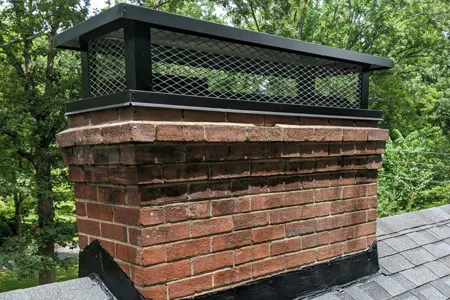
Why a stamped chimney cap from the home center doesn’t work
Walk into any big-box store and you can buy a chimney cap that “fits” 13”x13” or 21”x21” flues. They’re stamped from sheet metal, sold flat-packed, and intended for a contractor to slap on in fifteen minutes.
The problem is that real chimneys don’t measure in clean inches. A 1920s chimney in West End might have a 14.5” x 17” flue with mortar buildup that brings it to 15.5” x 18”. A modern prefabricated fireplace chimney has dimensions specific to its manufacturer. A double-flue chimney needs a cap that covers both flues with the right clearance and a drip edge over the masonry, and a stamped product simply won’t fit.
The stamped caps end up sitting an inch high on one side, or pinned in place with sheet-metal screws into mortar that crumbles within a few years, or held down with caulk that fails by year three. By year five, they’re rattling in the wind, lifting in storms, or just plain gone.
We measure your chimney, then provide a cap built to those exact dimensions in materials that last as long as the chimney.
What we install
Copper caps
The premium material. Copper develops a patina over the first 5-10 years (going from bright orange to a darker bronze to eventually the green you see on old churches). It will outlast your roof and your house. Copper caps are most common on:
- Historic homes (Buena Vista, West End, Ardmore, Reynolda Park in Winston-Salem; Fisher Park, Westerwood, Sunset Hills in Greensboro)
- High-end new construction
- Any home where the chimney is visible from the curb and worth treating as an architectural element
Stainless steel caps
The right balance of durability and cost. Stainless will last 30-50+ years, doesn’t patina, stays bright, and costs roughly 40% of copper. Best for:
- Modern and contemporary homes
- Homeowners who want a long-lasting cap without the copper price tag
- Commercial buildings
Galvanized (least common)
Available for budget-conscious projects, but the lifespan drops to 15-20 years and the appearance is industrial. We rarely recommend it for residential work.
What a proper chimney cap actually includes
A real chimney cap isn’t just a roof on a flue. It’s a system:
- Top plate — covers the entire crown of the chimney, not just the flue
- Spark screen — keeps embers from escaping and prevents birds, squirrels, and raccoons from nesting in your chimney
- Drip edge — overhangs the masonry on all sides so water runs off, not down the side of the chimney
- Standoff legs — proper height for draft clearance (the flue gases need room to escape)
- Multi-flue configurations — when you have two or three flues in one chimney, we provide a single cap covering all of them with the right clearance to each
- Decorative elements — finials, custom edge profiles, integral lightning arrestors when requested
Every cap is built around measurements we take at your house. No verbal estimates, no guessing.
When to install or replace a chimney cap
- Visible water staining running down the inside of your fireplace box or chimney chase — water is getting in through the top
- Rusty or torn existing cap — stamped caps usually fail at the corners or where fasteners go through
- Animal noises in the chimney — almost always means birds or squirrels have nested where a cap should be excluding them
- A new roof is being installed — the right time to also replace an aging or marginal cap, since the roofers are already there
- A new chimney is being built — get the cap on before the roofer leaves
When a cap is part of a bigger chimney problem
Sometimes the cap is fine and the leak is somewhere else:
- Chimney crown cracked — the concrete cap on top of the masonry, separate from the metal cap. Cracks let water into the masonry and freeze-thaw makes it worse. We can repair or rebuild crowns.
- Flashing failing at the roof — step flashing and counter flashing where the chimney meets the roof is a separate, very common leak source
- Mortar joints failing — vertical cracks in the chimney itself, repointing required
We assess the whole chimney before recommending a cap. If the cap is fine but the crown is failing, we tell you that.
Why Mid Atlantic for chimney caps
- Made to your chimney’s actual measurements — not stamped to fit
- Copper and stainless steel — the materials that last
- Multi-flue and complex configurations — we handle chimneys most contractors won’t quote
- Coordinated with roofing work — if you’re already getting a new roof, the cap goes on at the same time
- 3-year workmanship warranty
Schedule a chimney cap measurement
Call (336) 671-5208 or request an estimate online. We measure at your house, the cap is built to those dimensions, and we install in a follow-up visit.